
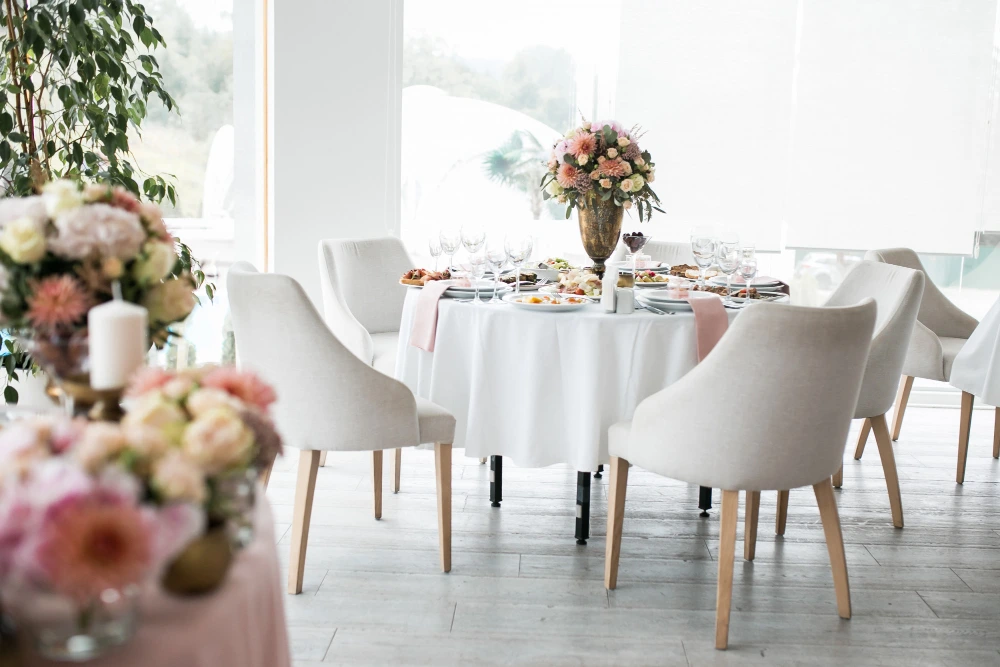
Banquet Chairs are far more than functional seating they are a defining element of every event’s atmosphere, guest comfort, and operational efficiency. This comprehensive guide for Perfect Banquet Chairs is designed for hotel procurement managers, event venue owners, and hospitality professionals who want to make smarter, longer-lasting seating investments. From understanding critical Banquet Chair Features to evaluating cost versus durability, this blog covers everything you need to choose confidently.
Picture a grand wedding reception, a packed corporate conference, or an elegant awards dinner. The décor is stunning, the catering is flawless and yet, halfway through the evening, guests are shifting uncomfortably, the chair legs are wobbling, and the upholstery is already showing scuff marks from the third event this week.
The seating choice made it or broke it.
Banquet chairs are among the most heavily used and most often underestimated items in any hospitality or event environment. They are present at every table, in every room, for every occasion. Getting this decision right has a direct impact on guest experience, operational efficiency, and the long-term cost of running a venue. Getting it wrong means repeated repair bills, premature replacements, and guests who won’t forget the discomfort.
This blog is the guide for Perfect Banquet Chairs that hotel owners, procurement teams, and event venue managers need covering capacity planning, durability standards, key Banquet Chair Features, and a grounded approach to cost that goes well beyond comparing price tags.
Understanding What Banquet Chairs Are Actually Required to Do
Before diving into selection criteria, it helps to understand the real-world demands placed on commercial banquet chairs in a professional hospitality context.
Unlike residential dining chairs, which may be used for an hour a day and rarely moved, banquet chairs for hotels and event venues face a relentless rotation of use. They are set up, sat in for two to five hours at a stretch, cleared away, stacked, transported across the venue, stored, and then repeated sometimes multiple times in a single day across different events.
This means every component of a banquet chair the frame, the joints, the padding, the upholstery fabric, the stacking mechanism must be engineered for commercial-grade repetition. A chair that looks beautiful in a catalogue photograph but is constructed with residential-grade joints and inadequate foam density will fail in a commercial hospitality environment far sooner than its price suggested it would.
Understanding this distinction is the first and most important step in the selection process.
Capacity Planning: How Many Chairs Do You Actually Need?
One of the most practical questions in any procurement decision is volume and for banquet chairs for hotels and event spaces, the answer is never simply “one per expected guest.”
Professional capacity planning for banquet seating should account for several overlapping factors. First, consider your maximum event capacity the largest seated event your venue can physically accommodate. Second, add a buffer, typically 10–15% above that figure, to allow for events that run simultaneously across separate rooms, last-minute guest additions, or chairs that are temporarily out of rotation for cleaning or repair.
Third, and often overlooked, is the stacking and storage dimension. Commercial banquet chairs need to be stored somewhere when they are not in use, and stacking height matters. A chair that stacks efficiently eight to ten units high in a compact storage space dramatically reduces your footprint requirements compared to a chair that stacks only four or five units and takes up twice the floor area.
Capacity planning is not just a purchasing exercise it is a space management and operational efficiency decision that deserves careful thought before a single order is placed.
Key Banquet Chair Features That Define Quality
Not all banquet chairs are made equal. Understanding the Banquet Chair Features that distinguish a genuinely durable, guest-worthy chair from a superficially attractive but underperforming one is central to making a sound investment.
Frame Construction and Material is the foundation of everything. Steel frames particularly those with welded rather than screwed joints offer superior strength and resistance to the stress of repeated assembly and disassembly. Aluminium frames offer a lighter alternative with good corrosion resistance, which is particularly relevant for venues that use seating in outdoor or poolside settings. Avoid frames that rely heavily on bolted connections at high-stress joints, as these are a common point of failure under commercial use conditions.
Foam Density and Seat Comfort determines how your guests feel after an hour of being seated and, critically, after three or four hours. High-density foam (typically 1.8 lb/ft³ or above for commercial applications) retains its shape and cushioning through repeated use cycles. Lower-density foam will compress and flatten relatively quickly, leaving guests sitting effectively on a hard base and generating the kind of discomfort that shows up in event reviews and guest feedback.
Upholstery Durability is another non-negotiable Banquet Chair Feature for commercial environments. Fabrics used in hospitality seating should be rated to a Martindale abrasion standard appropriate for high-traffic use typically 30,000 rubs or above for event venues with frequent turnover. Vinyl and faux leather alternatives offer easier cleaning and greater resistance to spills, which makes them particularly practical for dining events where food and beverages are in constant proximity to the seating.
Stackability and Weight define the day-to-day operational reality for your venue staff. A chair that cannot stack safely and efficiently will slow down room turnarounds, create storage chaos, and increase the physical burden on your team. Many purpose-built commercial banquet chairs include integrated stacking protection rubber bumpers or protective caps that prevent chairs from scratching one another during storage, preserving both appearance and surface finish over time.
Weight Capacity is a safety and liability consideration that must not be overlooked. Professional commercial banquet chairs should carry a clearly stated tested weight capacity, typically ranging from 300 lbs to 500 lbs for commercial-grade products. This is not a specification to guess at or assume confirm it in writing with your supplier.
Why Hotels and Event Venues Should Buy High-Quality Banquet Chairs
The argument for investing in quality seating is fundamentally economic, even when the upfront cost is higher. Hotels and Event Venues Should Buy High-Quality Banquet Chairs for reasons that compound over time.
A premium commercial banquet chair with a robust steel frame, high-density foam, and commercial-grade upholstery might carry a unit cost two to three times higher than a budget alternative. But if that premium chair lasts eight to ten years under intensive use while the budget chair requires replacement or significant repair within three to four years, the total cost of ownership calculation changes dramatically. Factor in the labour cost of managing repairs and replacements, the operational disruption of chairs being out of service during busy periods, and the reputational cost of guests sitting in deteriorating seating and the case for quality becomes compelling.
There is also a guest experience dimension that cannot be reduced to a spreadsheet figure. An event held in a hotel or venue where the seating is visually elegant, structurally sound, and genuinely comfortable leaves a different impression than one where chairs creak, wobble, or look worn. That impression influences returning bookings, online reviews, and the reputation a venue carries into its next sales cycle. This is precisely why Hotels and Event Venues Should Buy High-Quality Banquet Chairs as a deliberate, long-term strategic decision rather than a cost-minimisation exercise.
A Practical Overview of Banquet Chair Styles
The style of banquet chairs you select should align with both the aesthetic identity of your venue and the practical demands of your event types. A clear understanding of the most common styles prevents expensive mismatches between appearance and function.
Stacking Chairs are the standard workhorse of most commercial hospitality venues. Available in a wide range of materials, finishes, and upholstery options, they offer the best combination of versatility, storage efficiency, and commercial durability. For venues hosting diverse event types across multiple configurations, stacking chairs are typically the most practical choice.
Chiavari Chairs represent the premium end of formal event seating. Their distinctive spindle construction and refined silhouette make them a preferred choice for weddings, gala dinners, and high-end corporate functions. Despite their elegant appearance, well-manufactured Chiavari chairs are stackable and durable though they require more careful handling during storage to protect their finish.
Cross-Back Chairs suit venues with a heritage, rustic, or garden aesthetic. Their characteristic X-shaped back design makes them a popular choice for outdoor weddings, vineyard events, and boutique hospitality venues seeking a warm, characterful seating aesthetic that distinguishes them from the generic ballroom format.
Each of these styles carries different maintenance requirements, storage profiles, and aesthetic implications all of which should be evaluated in the context of your specific venue and event mix.
Cost Considerations: Thinking Beyond the Unit Price
Understanding the true cost of banquet chairs requires looking past the per-unit purchase price to the full lifecycle cost of the seating investment.
At entry-level price points, commercial banquet chairs are available from a relatively modest per-unit cost, though durability and aesthetic life expectancy at this tier are typically limited. Mid-range chairs offer a more balanced proposition improved frame construction, better foam quality, and greater upholstery durability representing the most practical choice for most hotel and venue procurement scenarios. Premium chairs, including hand-finished designs and specialised style categories like Chiavari, carry higher unit costs but deliver correspondingly longer operational life and superior guest experience outcomes.
When building a procurement budget, always factor in the cost of chair trolleys and dollies for transportation, protective covers for storage, periodic professional cleaning, and a contingency allowance for minor repairs. These ancillary costs are real and recurring, and omitting them from the budget calculation leads to unpleasant surprises in the operating cost line.
Bulk pricing is a standard expectation in banquet chair manufacturer negotiations volume orders of 100 units or more should always be negotiated with explicit reference to the total quantity, phased delivery requirements, and any ongoing supply relationship your venue may require for future expansion or replacement.
Choosing the Right Banquet Chair Manufacturer
The relationship between a venue and its banquet chair manufacturer or hotel furniture supplier is not a one-time transaction. As chairs wear, designs evolve, and venues expand, the ability to source matching replacement units or complementary new styles from the same supply relationship has genuine long-term value.
When evaluating any banquet chair manufacturer, look for transparency in their material and construction specifications, a clearly stated warranty policy that covers commercial use (not just residential), the ability to provide physical samples before a full order commitment, and evidence of experience supplying comparable hospitality venues at the scale you require.
A manufacturer who struggles to answer specific questions about foam density, frame welding standards, or weight-tested capacity should be approached with caution these are not technical obscurities, they are the foundational specifications of a commercial seating product.
Conclusion: Seat Your Venue for Success
Banquet chairs sit at the intersection of guest comfort, operational practicality, aesthetic identity, and long-term financial stewardship. Choosing them well with a clear understanding of Banquet Chair Features, a realistic approach to capacity planning, and a lifecycle view of cost is one of the most consistently impactful procurement decisions a hotel or event venue can make.
At Grouporise, we support hospitality businesses in making exactly these kinds of informed, strategic decisions. Whether you are equipping a boutique event space or a large-scale hotel banqueting operation, our expertise in commercial hospitality furniture ensures that every seating choice serves your venue, your guests, and your business for years to come.