
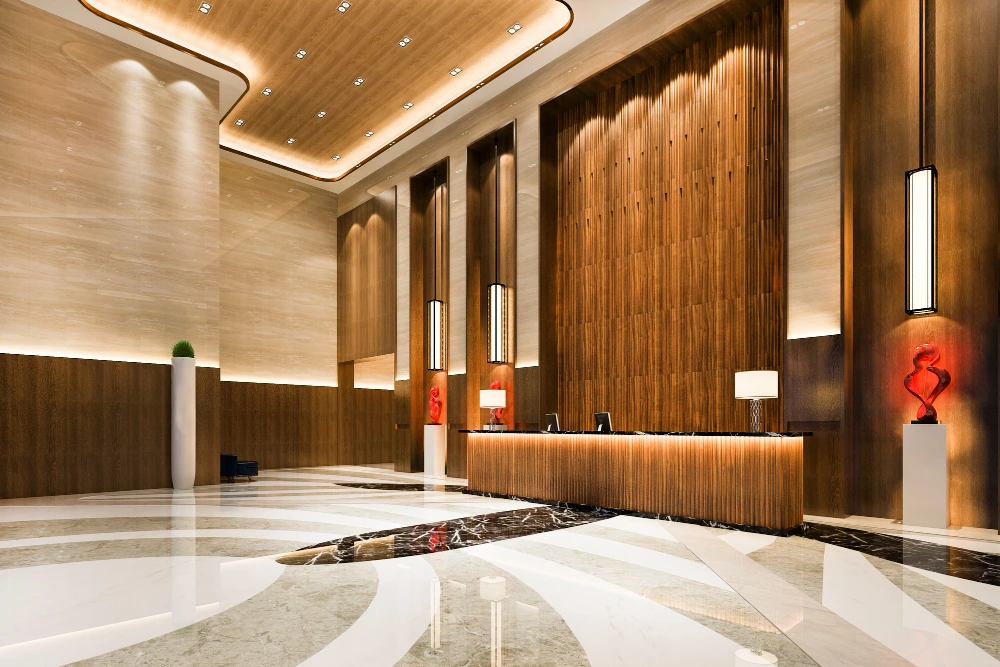
The hotel lobby is the first physical story a property tells every guest who walks through the door and lobby furniture procurement is the decision that determines whether that story communicates luxury, coherence, and quality, or signals compromise from the very first moment. This Hospitality Furniture guide is written for procurement teams, hotel development managers, and interior consultants navigating the complexity of bulk lobby furniture orders, covering everything from Commercial Lobby Furniture Design principles and material standards to supplier evaluation, budget structuring, and the critical pre-order steps that protect your investment and your timeline.
Before a guest reaches their room, encounters your restaurant, or experiences your spa, they spend time in your lobby. It is the first physical encounter with your property the moment where expectation meets reality, and where the brand promise either holds or begins to unravel.
Hotel reception furniture design does more than fill a space. It communicates the property’s positioning, signals the quality of what follows, and directly influences guest perception from the very first impression. A lobby that is beautifully composed, with furniture that is visually coherent, ergonomically considered, and clearly built to last, tells guests they have arrived somewhere thoughtfully managed and genuinely invested in their comfort.
For procurement teams handling a bulk furniture order whether for a new hotel build, a phased refurbishment, or a multi-property rollout the decisions made at this stage have consequences that extend across years of operational life. This guide for Best Hotel Lobby Furniture procurement covers the full scope of what must be understood, evaluated, and confirmed before a single purchase order is placed.
Why Lobby Furniture Procurement Is Different From Other Areas of the Hotel
The lobby occupies a unique position in the FF&E (Furniture, Fixtures & Equipment) scope of any hotel project. Unlike guest rooms, where furniture is used privately by one or two occupants at a time, the lobby is a high-traffic, publicly visible, multi-purpose environment that must perform under a constant and varied load.
At any given moment, a hotel lobby may serve as a check-in zone, a waiting area, an informal meeting space, a lounge for transit guests, a work environment for business travellers, and a social hub for groups. Each of these use cases places different physical demands on the furniture and all of them must be met simultaneously, by the same pieces, day after day.
Luxury hotel lobby furniture must therefore balance a set of competing imperatives: it must look premium and aesthetically consistent; it must be structurally robust enough to withstand constant, varied use; it must be comfortable across a range of seating durations; it must integrate with the hotel’s brand identity; and it must remain maintainable and replaceable at scale, often across multiple properties.
This complexity is precisely what makes lobby furniture procurement a strategically critical decision rather than a straightforward purchasing exercise. Teams that approach it with rigour and the right framework protect both the guest experience and the hotel’s capital investment.
What Goes Into a Hotel Lobby: A Procurement Scope Overview
Before evaluating hotel lobby furniture suppliers or comparing specifications, the procurement team must have a clear and complete picture of the lobby’s furniture scope. A comprehensive hotel lobby typically requires the following furniture categories:
The Reception Desk and Counter is the operational centrepiece of the lobby and the most visually prominent single piece of furniture in the space. It defines the guest’s first transactional experience and must communicate both brand personality and professional functionality. For Commercial Lobby Furniture Design, the reception counter must accommodate technology integration screens, card readers, cable management while projecting a visual quality commensurate with the property’s positioning.
Lounge and Seating Zones constitute the largest volume of lobby furniture in most properties. This category includes sofas, armchairs, accent chairs, ottomans, and banquette configurations, arranged into zones that serve different functions: arrival seating for guests waiting for check-in, social clusters for groups, quiet zones for solitary guests or business travellers. The seating must be genuinely comfortable for extended periods, upholstered in contract-grade fabrics that resist wear and are easy to clean, and designed in a style that complements rather than overwhelms the architectural character of the space.
Occasional and Coffee Tables complete the seating zones and must coordinate in material, finish, and scale with the surrounding seating. Table heights, surface areas, and edge profiles are all functional considerations, not merely aesthetic ones. A coffee table that is too low, too narrow, or too easily marked by drinks and devices will generate guest friction and maintenance costs in equal measure.
Concierge and Service Points require furniture that is both functional for staff use and visually consistent with the lobby’s overall design language. These pieces are often overlooked in the early stages of procurement scoping and then rushed at the end a sequence that produces mismatched results.
Decorative and Feature Elements feature consoles, display cabinetry, sideboards, and accent pieces complete the lobby environment and provide opportunities to express the property’s identity and differentiate from competitive neighbours.
The Critical Role of Commercial-Grade Specifications
The single most damaging procurement error in hotel lobby furniture is specifying or accepting residential-grade products for a commercial hospitality environment. It is a mistake that is typically only visible after installation and by then, the consequences are already embedded in the hotel’s maintenance schedule and replacement budget.
Commercial Lobby Furniture Design demands furniture built to commercial standards at every level: frame construction using kiln-dried hardwood or robust engineered composites; upholstery with Martindale-tested abrasion ratings of 30,000 rubs or above for upholstered seating; foam densities appropriate for sustained, high-frequency use; surface finishes resistant to staining, scratching, and discolouration; and joinery techniques mortise and tenon, corner blocking, dowelling that can withstand the physical stress of thousands of use cycles.
For luxury hotel lobby furniture specifically, material quality must also meet a higher visual standard. The surface grain of timber veneers, the quality of stone or marble top inserts, the weight and handle of hardware finishes, the consistency of upholstery stitching and piping these are the details that distinguish a genuinely premium lobby from one that aspires to luxury but falls short on close inspection. Guests in high-end properties notice these things, even if they cannot always articulate them.
When evaluating Hotel Furniture Suppliers: A Procurement Checklist for Hotels, procurement teams should always ask for explicit material and construction specifications in writing—not just rendered images or catalogue descriptions. A credible supplier will be able to provide technical data sheets, foam density certifications, fabric Martindale ratings, and structural load specifications without hesitation. Reluctance to provide this information is itself a meaningful signal.
Evaluating Hotel Lobby Furniture Suppliers for Bulk Orders
For a bulk lobby furniture order particularly for a new property or a multi-room refurbishment the supplier evaluation process is as important as the product selection itself. The wrong supplier for a large order can derail project timelines, deliver inconsistent quality, and leave the procurement team managing a crisis rather than a furniture installation.
The guide for Best Hotel Lobby Furniture supplier evaluation covers several dimensions that must all be assessed before commitment.
Hospitality-sector experience is the first and most non-negotiable filter. A supplier that primarily serves the residential or retail market may produce visually attractive furniture, but they are unlikely to understand the specific structural requirements, certification standards, or logistical demands of a large-scale hotel project. Ask specifically for hospitality project references completed hotel lobbies at comparable scale and quality level and pursue those references with real conversations, not just photographs.
Production capacity and lead time reliability become critical at the scale of a bulk order. A supplier capable of producing 50 pieces may not be capable of coordinating 500 pieces across multiple product categories on a construction-aligned timeline without quality or delivery compromises. Confirm in writing: What is the realistic production lead time for your order volume? What are the production milestones? What is the escalation process if milestones are missed? Lobby furniture procurement contracts for large orders should include written delivery schedules and, where possible, penalty clauses for late delivery that would affect a hotel’s opening date.
Customisation capability is particularly relevant for luxury hotel lobby furniture where the property’s brand identity requires bespoke dimensions, signature finishes, or proprietary design elements that cannot be sourced from a standard catalogue. Verify that the supplier has an in-house design and technical team capable of working from architect or interior designer drawings, producing shop drawings for approval, and managing production changes without losing schedule control.
Quality control infrastructure should be assessed at the production level, not just the delivery level. The best hotel lobby furniture suppliers operate in-house QC processes at every stage of production materials intake, frame construction, upholstery application, finishing, and pre-shipment inspection. Request QC documentation as part of the supplier evaluation, and consider including a factory visit or independent pre-shipment inspection clause in the contract for large orders.
Budget Structuring for Bulk Lobby Furniture Orders
One of the most consistent sources of procurement difficulty in hotel projects is incomplete budget construction where the unit price of furniture is well understood, but the full cost of procurement, delivery, and installation is not.
A realistic lobby furniture procurement budget for a bulk order must account for unit costs at the agreed specification, bulk order discounts negotiated with the supplier, packaging suitable for transit at scale, freight and logistics to site, installation and assembly labour, a contingency reserve of 10–15% of total furniture value to absorb specification changes, damage claims, or last-minute additions, and an ongoing maintenance and replacement budget for the operational life of the furniture.
Total cost of ownership is the correct financial framework for lobby furniture, not initial unit price. Higher-specification furniture that carries a greater upfront cost and lasts ten years under intensive commercial use will almost invariably cost less over its operational life than lower-cost furniture that requires significant repair or partial replacement within four to five years. For luxury hotel lobby furniture in a property where guest experience and brand reputation are core commercial assets, this calculation is particularly compelling.
Bulk order pricing from hotel lobby furniture suppliers should be negotiated explicitly, with clear thresholds at which volume discounts apply, and with the total procurement relationship including potential repeat orders, multi-property rollouts, and ongoing replacement requirements included as leverage in that negotiation.
Design Trends Shaping Hotel Lobby Furniture in 2026 and Beyond
Understanding contemporary hotel reception furniture design trends is important not merely as aesthetic guidance, but as a strategic input into procurement decisions because lobby furniture bought today must remain visually current and relevant for the next eight to ten years of operational life.
The dominant design directions shaping luxury hotel lobby furniture in 2026 reflect a broader shift in hospitality towards warmth, authenticity, and multi-functional spatial intelligence. Curved and organic forms have replaced the rigid angular silhouettes of the preceding decade, creating seating configurations that invite guests into more intimate, convivial arrangements. This trend has functional implications: semi-circular and modular curved sofas define social zones within open-plan lobbies in a way that straight-lined furniture cannot, improving guest dwell time and creating the kind of atmospheric arrival experience that generates both positive reviews and stronger ancillary spend.
Sustainable and responsibly sourced materials are transitioning from a procurement preference to a specification standard, particularly for properties targeting international brand partnerships or environmentally conscious guest demographics. FSC-certified wood, fabrics with responsible manufacturing provenance, and finishes with low VOC content are increasingly expected rather than exceptional in the Hospitality Furniture guide that governs modern procurement practice.
Modular furniture systems offer procurement teams a flexibility advantage that is increasingly valued in the context of multi-use lobbies. A modular seating configuration that can be reconfigured quickly for events, gatherings, or different occupancy patterns without requiring furniture replacement provides both operational agility and long-term procurement economy.
Technology integration discreet USB and wireless charging points embedded in side tables, consoles, and seating arms is no longer a premium feature but a standard guest expectation in business-oriented and mid-to-luxury tier properties. Lobby furniture that accommodates connectivity without visual clutter is both practically necessary and aesthetically preferable to the retrofitted charging solutions that frequently compromise an otherwise considered interior.
Pre-Order Checklist: What to Confirm Before Committing to a Bulk Lobby Order
The following checklist consolidates the most critical pre-order confirmations for any significant lobby furniture procurement engagement:
Specifications and Approvals
- Written material specifications including foam densities, fabric Martindale ratings, and frame construction details
- Physical samples of all specified materials and finishes approved by the design team
- Shop drawings or technical drawings reviewed and approved before production commences
- Mock-up or prototype approved for key pieces (reception desk, primary seating items)
Supplier Qualification
- Hospitality project references confirmed with direct contact to previous clients
- Production capacity verified against order volume and project timeline
- QC process documentation reviewed and accepted
- Certifications (ISO, FSC, BIFMA or equivalent) confirmed in writing
Commercial and Logistics Terms
- Bulk order pricing confirmed with all applicable volume discounts applied
- Production and delivery milestones agreed in writing with penalty provisions for delay
- Packaging specification reviewed and accepted
- Delivery sequencing plan aligned with site readiness and installation schedule
- Warranty terms confirmed for commercial hospitality use (not residential-grade warranty)
Budget Integrity
- Total landed cost calculated including freight, installation, and contingency reserve
- Total cost of ownership assessed across projected furniture lifespan
- Replacement and maintenance cost provision included in operational budget
Conclusion: Procure With the Long View
Lobby furniture procurement for a hotel is a decision that will live in the property’s guest experience for a decade or more. The choices made about specifications, suppliers, materials, design, and commercial terms will either compound into an asset that reinforces the property’s positioning year after year, or compound into a liability that requires remediation and replacement far sooner than any budget anticipated.
The best procurement outcomes are achieved by teams who approach the lobby as a strategic environment rather than a shopping list, who evaluate hotel lobby furniture suppliers on process capability and not just product aesthetics, who build total cost of ownership into their financial models from the outset, and who insist on the physical evidence samples, mock-ups, references that protects the quality of their investment before a single bulk order is confirmed.
At Grouporise, our expertise in Commercial Lobby Furniture Design and large-scale hospitality procurement is built on precisely this approach. Whether you are equipping a single luxury property or managing a multi-site hotel rollout, we bring the specification rigour, supplier relationships, and design intelligence to ensure your lobby furniture investment delivers the first impression and the lasting performance your guests and your brand deserve.